· by Rédaction
Learning a Language on Random Video Chat: The Method Nobody Told You About
Random video chat is the cheapest language lab in the world. Here's how to turn chance encounters into genuine speaking practice, with no textbook and no teacher.
You have three learning apps on your phone. You've got a daily streak going, a passive vocabulary of several thousand words, and you understand pretty much everything in an English-language podcast if you concentrate. Then a Scotsman appears on screen, says something at full speed, and you answer "yes" with a strained smile before clicking next.
That gap is no mystery. It has a name in language teaching: the divide between receptive and productive competence. You can spend years piling up vocabulary without ever training the muscle that really counts — the one that produces a sentence, in real time, in front of someone waiting for an answer.
Random video chat is probably the most underrated tool for closing that gap. Not because it's magic, but because it brings together three conditions that neither apps, nor evening classes, nor even language trips manage to combine so easily: native speakers in quantity, a real emotional stake, and a cost of failure that is strictly zero.
Why an App Will Never Replace a Stranger Waiting for Your Answer
An app asks you a question and gives you all the time in the world. You can think for ten seconds, listen again, correct yourself. None of that exists in real life: in a conversation, the tolerated response window is about one second. Beyond that, the other person takes the floor again or checks out.
This is what linguists call production under time constraint. Work on second language acquisition — notably Merrill Swain's output hypothesis, formulated back in the 1980s — insists on this point: it is by being forced to produce, and to notice the holes in your own production, that you reshape your interlanguage. Comprehension alone is not enough. You need that uncomfortable moment when you're reaching for a word you don't have.
Random video chat industrialises that uncomfortable moment. In one hour, you can live through it forty times. No private tutor offers you that density.
There's a second, more discreet factor: the stakes. When you talk to an app, failing costs nothing. When you talk to a Brazilian woman who seems nice and whom you'd like to keep on screen for another five minutes, failing costs something. That small dose of social pressure is exactly the fuel that classroom learning never manages to manufacture.
The "I'll Practise When I'm Better" Trap
This is the reasoning that blocks the most people. You tell yourself you'll go and talk to native speakers once you've finished module 14, once you've mastered the past tense, once you have less of an accent. That day never comes, because the very skill you're aiming at can only be acquired through the exposure you keep putting off.
You have to flip the logic: your current level isn't a prerequisite, it's your starting point. And random video chat has a property nothing else has — total anonymity and instant endings. If you make a fool of yourself, the person disappears forever with one click. There's no colleague who will remember, no teacher taking notes, no conversation group to go back to the following week carrying the shame of last time.
Chatroulette is the only place in the world where you can fail forty times in a row in front of forty different witnesses, without a single one of them ever knowing.
That absence of social memory is a pedagogical gift. Use it.
Structuring a Session: From Lottery to Training
An unstructured session produces little progress. You log on, you talk a bit, you congratulate yourself on having "practised", and you start again the following week having forgotten everything. Here is a simple framework, tested by plenty of self-taught learners, that turns an evening of chance into a training session.
1. Set a single goal per session
Not "get better at English". Something measurable and narrow:
- work in an idiomatic expression learned the day before three times;
- never say "I don't know" and replace it with a rephrasing;
- hold five conversations of more than two minutes without switching back to your own language;
- systematically ask a follow-up question after every answer.
One goal per evening. The brain does not consolidate ten targets at once.
2. Show your hand in the very first sentence
It's counter-intuitive, but saying straight away "I'm French, I'm trying to improve my English, would you mind chatting for five minutes?" massively increases your retention rate. You turn a potential flaw — your hesitations — into an explicit framework. The other person knows what to do with you. Many even become supportive, because most people enjoy being in a position to help.
3. Keep a written record
This is the step everyone skips and the one that makes all the difference. During the session, jot down on the fly the words you were missing and the turns of phrase the other person used that you wouldn't have produced yourself. A spiral notebook sitting next to the keyboard is more effective than a file open in a browser tab: raising your hand to scribble three words breaks eye contact far less than clicking into another window. You reread it the next day, keep five items, and recycle them in the next session. That production → gap → review → reuse cycle is the heart of the whole system.
4. Alternate roles
A good session has two phases. The first, in learner mode, where you struggle along in the target language. The second, in expert mode, where you let the person opposite practise their French. This reversal does more than make the exchange fair: explaining your own language forces you to become aware of it, and will make you spot mechanisms in the other person's language that you couldn't see before.
Equipment Makes a Huge Difference — More Than in Your Own Language
Speaking your mother tongue with mediocre sound is workable: the brain reconstructs the missing words. In a foreign language, that reconstruction no longer works. A lost syllable becomes a lost word, then a lost sentence, then one "sorry, can you repeat?" too many that kills the conversation.
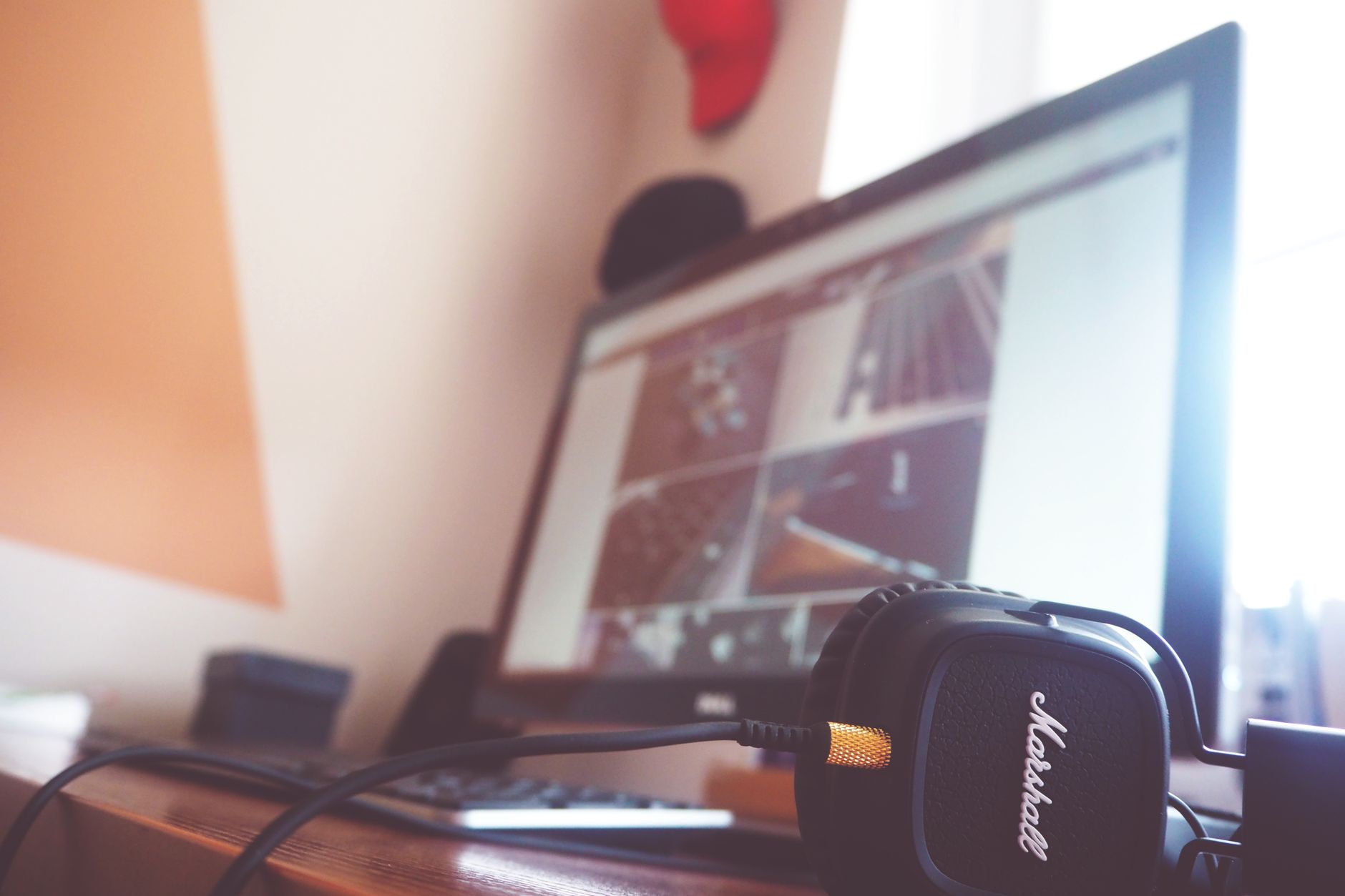
That's why investing in hardware pays off far more here than elsewhere. A USB headset with a boom mic and noise cancellation solves half the problem: you hear final consonants, liaisons, and contracted forms that textbooks never show you. And the other person hears you clearly, which stops them blaming your accent for what is really down to your microphone.
Second, often overlooked point: lip reading. People underestimate how much they read lips to understand a foreign language — an effect documented since the work of McGurk and MacDonald on the audiovisual integration of speech. If your face is badly lit, you lose part of the information. An adjustable LED ring light, placed facing you, improves your comprehension as much as your image, because the other person will be reading your lips too.
Finally, if you practise in the evening in a shared flat, a closed-back headset with passive isolation stops you turning the volume beyond reasonable levels and shields you from the household noise that interferes with listening to a language you haven't mastered.
The Mistakes That Cost You Six Months
Looking only for native speakers of your target language
Counter-intuitive again: the best training partners for an intermediate level are not always native speakers. A Pole or an Indonesian who speaks English as a lingua franca speaks more slowly, articulates more, and uses simpler vocabulary. This is the famous "international English", and it's by far the one you'll use most in real life. Reserving 100% of your practice for native speakers means condemning yourself to permanent failure early on.
Translating in your head
As long as you build the sentence in your own language before converting it, you'll never keep up with the rhythm of a conversation. The method that works: accept producing shorter, poorer sentences, but directly in the target language. Three accurate words beat a perfect subordinate clause that arrives four seconds too late.
Bailing out as soon as it gets hard
The reflex to click is the learner's worst enemy. Clicking when you don't understand amounts to deleting exactly the situation you needed. Set yourself a rule: before moving on, always attempt a repair. "Sorry, I missed that — the last part?" That emergency sentence, learned by heart, is worth fifty lessons.
Practising only small talk
Hello, where are you from, how's the weather. After thirty conversations, you'll have become excellent... at the first thirty seconds of a conversation, and useless everywhere else. Deliberately push towards territory where your vocabulary is weak: work, local food, politics if the mood allows, a film you've both seen. That's where the words you're missing live.
A Realistic Eight-Week Programme
| Week | Goal | Session length | Success indicator | |---|---|---|---| | 1-2 | Break the fear of speaking | 20 min, 3×/week | No more hanging up in panic | | 3-4 | Hold 3 minutes without switching back to French | 30 min, 3×/week | 5 conversations > 3 min | | 5-6 | Enrich thematic vocabulary | 30 min, 4×/week | 10 words from the notebook reused | | 7-8 | Fluency and follow-up questions | 40 min, 4×/week | Conversations > 10 minutes |
That rhythm works out at roughly two hours a week. It looks like little on paper, but they are two hours of pure spoken production — the equivalent, in terms of personal speaking volume, of several months of group classes where you actually speak for a few minutes per session.
For the offline review part, a columned vocabulary notebook or a set of plain index cards is plenty: what matters isn't the tool but the reuse loop. Some learners add a book of English idioms to supply each session with fresh ammunition, which stops you rehashing the same stock of ready-made phrases.
What It Changes Beyond the Language
The unexpected benefit of this practice is that it incidentally solves a broader problem: the fear of being judged. You start out wanting to improve your accent, and you end up discovering that you dare far more than you used to — including in your own language, including offline.
There's also a cultural dimension that no textbook conveys. Discovering that a Japanese person laughs before saying no, that an Argentinian interrupts as a sign of interest rather than rudeness, that a Finn leaves four-second silences without it meaning anything at all: those things can only be learned face to face.
Finally, a word of caution, because language practice doesn't suspend the basic rules. Stick to the same reflexes as for any random video chat session: no surname, no precise location, no personal accounts handed over lightly, and a curtain or a neutral wall behind you. If an exchange becomes uncomfortable, the best sentence in the English language is still "nice talking to you, bye" followed by a click. Data protection authorities regularly point out that information shared online in a moment of warmth can't be taken back.
You don't need a plane ticket, or a teacher, or a minimum level. You need a camera, a clear goal, and the willingness to stay on screen three seconds longer than panic advises. The rest will be handled by dozens of well-meaning strangers.