· by Rédaction
Talking to a Stranger Who Doesn't Speak Your Language: The Improvised Conversation Guide
On random video chat, half the strangers you meet don't speak your language. Here's how to turn the language barrier into an asset rather than a reason to hit "next" — accent, gestures, translation, pacing.

There's a very particular sound on random video chats: a stranger starting a sentence in a language you don't understand, stopping dead, and looking at you. An awkward half-smile on both sides. Then, nine times out of ten, the screen changes. Next.
That's probably the single biggest waste in all of video chat. Because those three seconds of hesitation don't signal an impossible conversation: they signal a conversation that requires a different protocol. And very few people have ever learned that protocol, even though you can pick it up in one evening.
The language barrier isn't a wall. It's a filter. It weeds out autopilot small talk, canned jokes and filler questions — and it lets something else through: the face, the rhythm, the intent. Plenty of regulars will tell you their best sessions happened with someone they didn't share thirty words with.
Who's Really on the Other Side
French speakers are a small minority, and that's structural
You have to face the numbers. The Organisation internationale de la Francophonie estimates the number of daily French speakers at around 320 million people worldwide — barely 4% of the global population. On a global platform with no geographic filter, the odds of landing on a French speaker are therefore mechanically low, except during peak European hours.
English, on the other hand, is spoken to varying degrees by roughly 1.5 billion people according to Ethnologue's estimates, but the vast majority of those speakers aren't native. In other words: in a typical international video chat conversation, you have two people using a second language, with thick accents on both sides, limited vocabulary and zero pretence of perfection.
That's excellent news. Nobody is grading your grammar. You're not sitting an exam.
The three profiles you'll run into
In practice, non-French-speaking partners fall into three categories, and each calls for a distinct approach:
| Profile | Telltale sign | What works | |---|---|---| | The occasional English speaker | Replies in schoolbook English, hunting for words | Very short sentences, one topic at a time | | The zero-shared-language case | Smiles, points at things, types in the chat | Gestures, objects, written translation | | The motivated learner | Explicitly asks you to speak French | Slowness, clear articulation, gentle corrections |
The third profile is the most underrated. Millions of people around the world are learning French — the OIF counts more than 50 million learners — and many come to video chat platforms precisely to find a native speaker. Without knowing it, you're a rare resource. That completely changes the dynamic of the conversation: you're no longer the one who has to win someone over.
The First Thirty Seconds Protocol
Slow down before you enunciate
The number one mistake French speakers make with a foreigner is shouting. We turn up the volume as if the misunderstanding were a hearing problem. It doesn't help, and it comes across as irritation.
What actually helps is breaking things up. A non-native speaker doesn't trip over isolated words, they trip over liaison and elision. "J'sais pas c'que tu veux dire" is unintelligible; "Je ne comprends pas" comes through fine. Linguists call this speech stream segmentation: your native brain segments automatically, the other person's doesn't.
Three simple adjustments:
- Cut your speaking rate by a third, not your volume.
- Pronounce words in full: "il y a" rather than "y a".
- Pause after each idea, not after each sentence — that gives decoding time.
In this specific case, sound matters more than picture
When you share a language, you tolerate a mediocre mic: the brain reconstructs what's missing from context. When you don't share one, that crutch disappears. Compressed, clipped or choppy audio makes a cross-language conversation simply impossible.
This is the one case where I'd unhesitatingly advise investing a minimum in gear rather than in your backdrop. A USB condenser microphone sitting in front of you does more for your international encounters than any ring light. Failing that, a headset with a boom mic brings the capsule closer to your mouth and kills the room echo, which is the real intelligibility killer.
Check your sound environment too: the reverb of an empty room, a fan, a washing machine next door. What you no longer notice, the other person hears at full blast.
Making Meaning Without Shared Vocabulary
Objects make better sentences than words
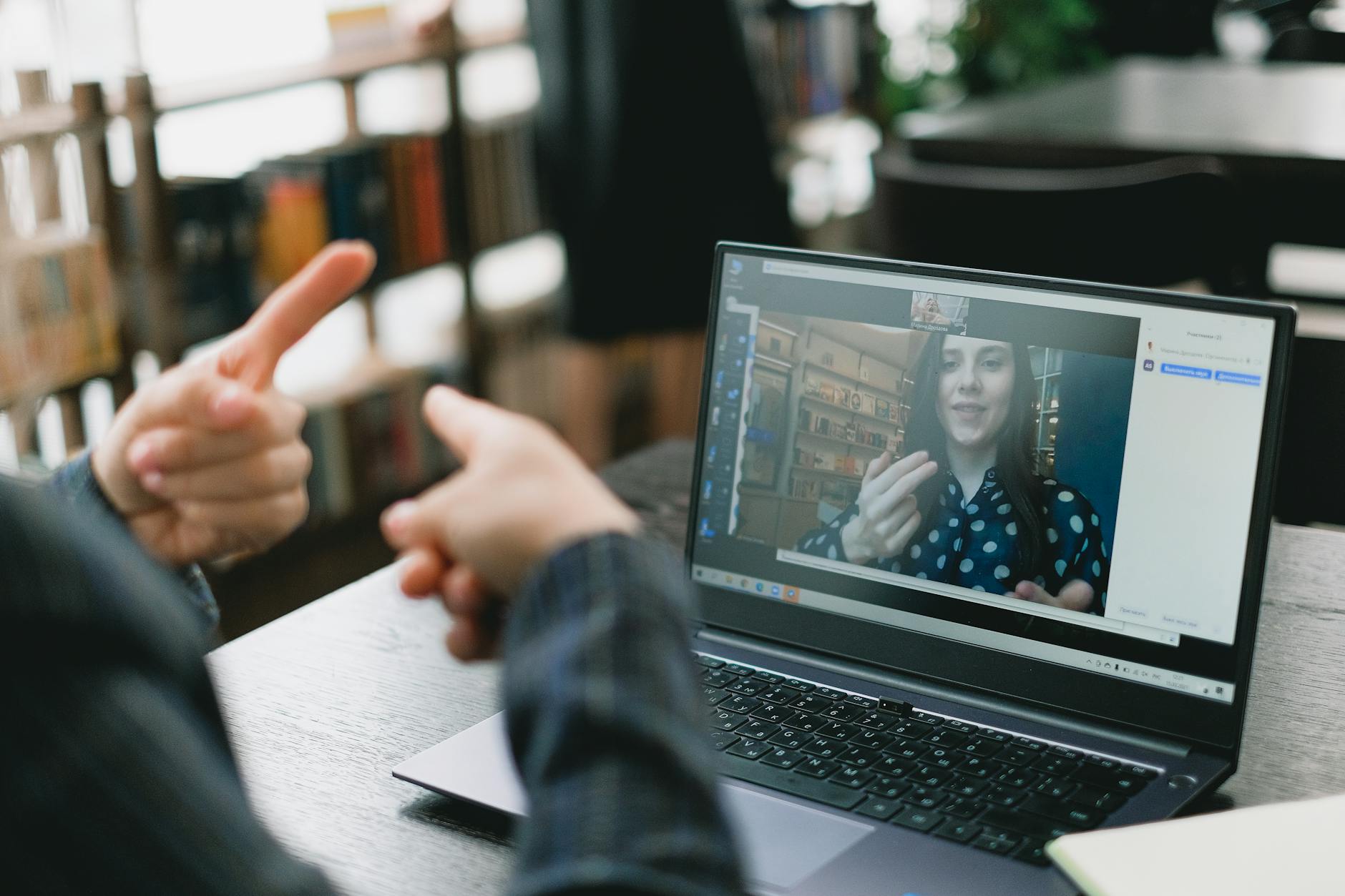
Here's the real secret of international chat regulars: when language gives out, you show. Video chat has an overwhelming advantage over text messaging — you have a camera and an entire room around you.
Holding up a coffee mug, a book, a musical instrument, the view out the window, a pet wandering past: each of those gestures creates an instant topic, universal and unambiguous. It's the grown-up version of charades, and it works remarkably well.
A few props turn this constraint into a game:
- A notepad and a thick black marker: you write a word, you hold it up to the camera. Reading comprehension is often far better than listening comprehension for a learner.
- A small globe or a wall map: "where are you from?" becomes a question you settle in two seconds, by pointing.
- A standard deck of cards: the rules of War can be understood without a single word, and ten minutes go by effortlessly.
That last point deserves a pause. Games are the most universal social structure there is. They provide a goal, turn-taking and an ending — exactly the three things missing from a conversation with no shared language.
Live translation: useful, but keep it in its place
Machine translation tools have made a leap in recent years. DeepL and Google Translate now handle short, concrete sentences very decently; their mobile versions even offer voice input and read-aloud.
But be careful how you use them. Translation works for getting out of a specific jam — a blocking word, an address, a two-line explanation. It doesn't work as a continuous mode of conversation: the latency kills the rhythm, and you spend the session staring at your phone instead of the face in front of you. And that face is precisely the added value of the format.
Practical rule: translation is there to unblock, never to carry the conversation. Type the word, show the screen, come back to the camera.
Three technical precautions:
- Never paste personal information into an online translator — full name, address, work-related details. The CNIL regularly points out that data entered into online services can be stored and reused to improve models.
- Beware of literal translations of compliments: what's charming in French often comes out crude elsewhere.
- Keep a second device for translation if you can — a basic tablet next to the keyboard saves you from blocking your camera with every query.
Accent: The Fake Problem That Became a Real Asset
What research says about "accent bias"
There's a documented phenomenon: accent bias, the tendency to judge a speaker with a strong foreign accent as less credible. A classic study by Shiri Lev-Ari and Boaz Keysar, published in 2010 in the Journal of Experimental Social Psychology, showed that identical statements were judged less truthful when delivered with a non-native accent — not out of conscious prejudice, but because the cognitive processing effort is mistakenly perceived as a signal of doubt.
In other words: if the person you're talking to seems hesitant to believe you, it isn't necessarily about you. It's processing fluency.
The good news is that this effect fades very quickly with exposure. After a few minutes, the ear adapts to a given accent — researchers call it perceptual adaptation. Concretely: the first two minutes of a cross-language conversation are always the hardest. If you hit next at the first misunderstanding, you're systematically nexting right before the moment it gets easy.
Hold on for another hundred and twenty seconds. That's the whole advice.
Your French accent is an asset, not a handicap
This needs saying plainly, because so many French speakers apologise for their English in the very first sentence: the French accent enjoys, rightly or wrongly, an extremely favourable reputation across much of the English- and Spanish-speaking world. You have nothing to gain from erasing it, and even less from apologising for it.
What sinks a conversation is never the accent. It's the constant apology: "sorry, my English is very bad", repeated every three sentences. It shifts the conversation onto your insecurity instead of leaving it on the topic.
Say it once, with a smile, and never bring it up again.
Turning Chat into a Training Ground
Video chat as a language lab
This is the most underused application of the format. A ten-minute conversation with a stranger is worth, in terms of real exposure, far more than half an hour on a phone app — because there's an immediate social stake, time pressure, and zero possibility of cheating.
Language teaching specialists talk about learning in authentic contexts. The Council of Europe, in the Common European Framework of Reference for Languages, has long insisted on the action-oriented approach: you learn a language by carrying out real tasks with it, not by memorising lists.
To get something lasting out of it, add a minimum of structure:
- After each session, jot down the two or three words you were missing. A pocket vocabulary notebook within reach while you chat is enough; the act of writing fixes things better than copy-paste.
- Target one language per evening rather than flitting around.
- Accept being corrected, and offer the same in return: it's the fairest implicit contract in video chat.
Many platforms offer a language or region filter. Use it backwards: instead of selecting your mother tongue to stay on familiar ground, select the one you're working on.
A supporting offline method, all the same
Video chat maintains and unblocks, but it doesn't build foundations from scratch. If you're starting from a long way back, a language course with audio files worked through twenty minutes a day will give you the framework that conversations then come along and fill. One doesn't replace the other: the textbook supplies the structures, the stranger on screen supplies the speed and the nerve.
Limits Worth Knowing
Cultural misunderstandings: language is only half the problem
Two people can speak perfectly functional English and still misread each other completely. The acceptable level of intimacy in a first conversation, the place of ironic humour, distance from the screen, the way you say no — all of it varies enormously from country to country.
A few habits that head off 90% of incidents:
- Avoid irony and deadpan until a rapport is established: it's what translates worst.
- Don't open with political or religious questions, even "just to chat".
- Assume an embarrassed laugh means no. In many cultures, a direct refusal is impolite; the awkward smile is the real signal.
Safety doesn't translate
One thing never to relax in the name of intercultural goodwill: the rules of caution stay identical whatever the language. Don't share identifying information, don't show your street through the window, be wary of quick requests to move to another messaging app.
Romance scams online often exploit the language barrier as a pretext: "bad French" serves to justify inconsistencies, "machine translation" to explain odd sentences. Cybermalveillance.gouv.fr and the French Interior Ministry's THESEE platform document exactly this pattern. Someone who declares their affection within three messages while refusing to turn on their camera isn't shy: they're probably not the person they claim to be.
Finally, if you're chatting late and at length in a foreign language, be aware that the comprehension effort is genuinely tiring — researchers call it listening cognitive load. A warm-light desk lamp and a session capped at an hour beat a whole night spent decoding sounds in the dark.
In Summary
The language barrier is video chat's last great natural filter. It discourages 90% of users, which means a minimal effort puts you straight into the remaining 10% — the people others actually want to stay with.
Three things to remember:
Slow down instead of shouting. Show instead of explaining. And hold on two minutes longer than your next reflex: that's exactly how long an ear needs to get used to an accent.
The rest — vocabulary, turns of phrase, ease — will come on its own, one conversation at a time.