· by Rédaction
The First Five Seconds: What the Other Person Decides Before You Even Speak
On a chatroulette, the sorting happens in a matter of seconds, before the first word. Here's what's really at stake in that brief moment and how to take back control of your framing, your posture and your opening line.

There's a very particular moment on a chatroulette, and it lasts almost no time at all. The screen loads, a face appears, and somewhere between the first pixel and the first syllable, a decision has already been made. Stay, or hit next.
You've done it hundreds of times without thinking. And hundreds of times, it's been done to you. What's frustrating isn't the rejection itself — you get used to that — it's not understanding what it's based on. You imagine a brutal aesthetic judgement, a hierarchy of faces, and conclude there's nothing you can do about it.
In most cases, that's simply wrong. What happens during those five seconds is almost never a verdict on your looks. It's the rapid processing of a handful of signals — framing, lighting, posture, gaze direction, expression, perceived intent — most of which are entirely within your control. This article takes that mechanism apart, then explains how to rebuild an opening that makes people want to stay.
What the Brain Processes Before the First Word
Snap judgement isn't cruelty, it's economy
Social psychology has long documented how fast first impressions form. The work of Janine Willis and Alexander Todorov, carried out at Princeton University and published in Psychological Science in 2006, showed that a tenth of a second of exposure to a face is enough to form judgements of trustworthiness and competence — and that allowing more time doesn't change those judgements, it merely strengthens the judge's confidence in them.
Translated to a chatroulette: the person on the other end has already formed an impression before your webcam has finished stabilising its exposure. They aren't "thinking," they're reacting. And they're reacting not only to your features, but to a bundle of contextual information arriving at the same time.
The six signals processed in parallel
| Signal | What it conveys in one second | | --- | --- | | Framing | Your attention to the exchange, your command of the tool | | Lighting | How readable your face is, and therefore how readable your emotions are | | Posture | Openness or withdrawal, availability or passivity | | Gaze direction | Presence or distraction | | Facial expression | Friendly, neutral or hostile intent | | Background | Social context, discretion, effort invested |
None of these six elements has anything to do with your beauty. All of them have to do with your perceived availability. The unconscious question the other person asks isn't "do I find this person attractive?", it's "is this person going to give me something?" A conversation, a laugh, a surprise, a bit of attention. If the instinctive answer is no, the hand hits next.
Framing: the Most Common Mistake and the Easiest to Fix
Too far, too low, too much ceiling
Three flaws come up again and again. The first: the camera placed too low, usually a laptop lying flat on a coffee table or on your knees. The upward angle distorts the face, flattens the eyes and creates an unintended sense of looming. The second: a tiny face in one corner, lost in an entire room. The third: two thirds of the screen taken up by an empty wall above your head.
The right framing is easy to remember: eyes on the upper third of the image, head and top of the shoulders visible, camera at eye level or very slightly above. This rule comes from portrait photography and works for the same reason — it reproduces the distance at which two people actually talk to each other, about a metre.
On a laptop, reaching that height means raising the machine. A stack of books will do for the first few evenings, but an adjustable laptop stand settles the matter for good — and incidentally does wonders for your neck. For those using an external webcam, a small desktop tripod lets you decouple the camera angle from the screen angle — it's the best way to get a gaze that appears to be directed at the other person.
What your framing says about you whether you like it or not
Sloppy framing isn't neutral: it sends the message that the exchange didn't warrant ten seconds of preparation. And visible effort is a strong currency in random video chat, where almost nobody makes any. You don't need a studio; you need to look like you thought about the person on the other side.
Lighting: Making Your Emotions Readable
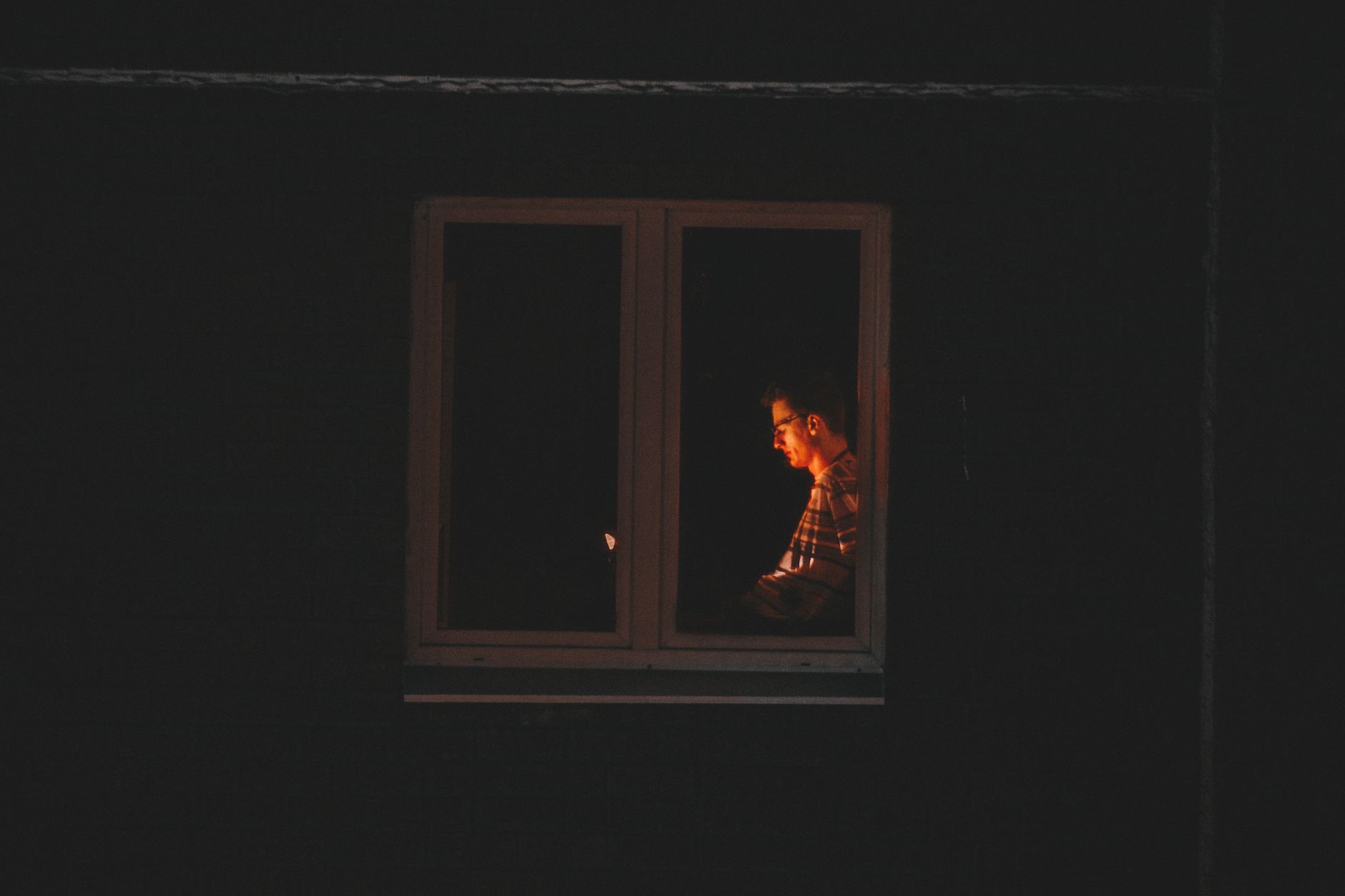
An unreadable expression is an absent expression. If your face is sunk in shadow or lit only by the bluish glow of your screen, all your expressive work is wasted — the other person sees a silhouette, not a smile.
The basic principle fits in one sentence: the light source must be in front of you, not behind. A window during the day, a desk lamp aimed at the wall facing you in the evening. Backlighting, very common when you sit with your back to a window, turns anyone into a shadow puppet.
For night sessions, which account for the bulk of chatroulette traffic, a continuous light lamp with adjustable colour temperature radically changes the result. Set to around 4000 K, fifty centimetres off to one side and slightly above eye level, it produces a soft light that sculpts the face instead of flattening it the way a ring light placed dead ahead would.
One detail few people check: built-in webcam sensors cope very badly with low light. In dim conditions they push the gain up and digital noise explodes. The result is a grainy image that looks like an unstable connection — when the problem is simply the lighting in your room.
Posture and Gaze: the Two Human Signals
The body speaks faster than the mouth
A slumped posture, back against the chair, shoulders low, conveys one thing: I'm here by default. Sitting up, leaning your torso slightly towards the camera, keeping your shoulders open is enough to flip the reading. This isn't about military stiffness, it's about orientation: a body turned towards the other person signals interest, on a video call as much as in a café.
Hands matter too, and this is an underrated point. Framing that includes them at least partially makes what you say more alive and, in terms of trust, more reassuring. Visible hands have always been a calming signal in human interaction.
Look at the camera, not the face
The video chat paradox is well known: looking at the other person's face on screen makes them feel you're looking elsewhere. For them to perceive eye contact, you have to look at the lens — a two-millimetre black dot, roughly as charismatic as a keyhole.
The method that works isn't staring at the lens permanently, which produces a fixed, slightly unsettling gaze. It's alternating: camera during the important moments — the greeting, a question asked, an answer listened to attentively — screen the rest of the time. Moving the other person's window to the top of your screen, just below the lens, mechanically reduces the gap and makes the alternation far less noticeable.
The First Five Seconds: the Protocol
What not to do
- Waiting in silence for the other person to speak first. Half of all connections die this way, through symmetrical waiting.
- Opening with "hi how's it going". It's a formula that invites no interesting reply and signals zero effort.
- Immediately asking age, sex and location. That sequence reads as administrative screening, not as the start of a conversation.
- Fidgeting frantically, adjusting your camera, standing up. Restlessness reads as chaos.
What works
An effective opening comes in three beats, all within the first five seconds.
One. The non-verbal signal, immediate: a genuine smile and a small wave. It sounds silly; it's nonetheless the most reliable trigger. A gesture of greeting activates a norm of reciprocity — the other person wants to respond before they've even decided whether to stay.
Two. A short sentence, addressed to them. Not "hi", but something carrying information or intent: "Hi, you're the first person not to skip me in three minutes", "Evening, I'm trying this thing for the first time, go easy on me", "Hi, quick question: what time is it where you are?" A sentence that invites a specific answer is worth a hundred generic greetings.
Three. A deliberate two-second silence. Give the other person time to process the image, the sound, the sentence, and to formulate a reply. Barrelling on without pausing produces the opposite of the desired effect: you sound like you're filling space.
The goal of the first five seconds isn't to seduce. It's purely to buy the next twenty. Every slice of conversation exists only to earn the one that follows.
Sound: the Signal Everyone Forgets
A visually successful opening can be destroyed by an inaudible first word. A laptop's built-in microphone picks up the fan, the keyboard, the room's reverberation, and buries your voice far behind. The other person hears mush, and moves on — not out of rejection, but out of anticipated fatigue.
A simple headset with a boom mic positioned a few centimetres from your mouth solves 90% of the problem, for a trivial budget. Those who want to stay visually discreet — no headset on screen — turn to a USB desktop microphone placed out of frame and aimed at them. In both cases, the gain in clarity is immediate and translates directly into longer average conversations.
One test worth doing once and for all: record yourself for thirty seconds with your phone's voice recorder placed where your chat partner would be, then listen. You'll hear what everyone else has been hearing for months, and it will probably be an unpleasant surprise.
Fix What Can Be Fixed, Accept the Rest
A note of honesty to finish. Even with impeccable framing, careful lighting and a well-rehearsed opening, you'll still get skipped often. That's structural: on a random video chat service, the overwhelming majority of users are looking for a specific profile, have been at it for two hours, or simply don't feel like talking to anyone that evening. No amount of preparation compensates for a mismatch of intentions.
What preparation changes is the rate. Going from two conversations per hundred connections to eight or ten isn't spectacular from the outside, but it completely transforms the experience of an evening. And it shifts the mental load: when you know you've done what you could with the controllable variables, being "nexted" stops being information about you.
For anyone interested in the subject beyond the screen, accessible books on non-verbal communication — Joe Navarro's classic on body language in particular — offer insights that work just as well in an office corridor as in front of a webcam. Reading micro-expressions, managing space, the role of the hands: all of it transfers, as long as you account for the restricted frame of the image.
The ten-minute checklist
Once, one evening, before you log on:
- Raise the camera to eye level.
- Frame your head and the top of your shoulders, eyes on the upper third.
- Put a light source in front of you, never behind.
- Check what's in the frame behind you.
- Test your microphone by recording yourself.
- Prepare two opening lines that invite a reply.
- Move the video window just below the lens.
Ten minutes of setup, good for months of sessions. It's probably the best effort-to-result ratio available on a chatroulette — and paradoxically, it's what almost nobody does.